

The Virkot Villa
At the edge of the world, four men and a dog run a hotel.

Virkot is a place between places, by most definitions functional only as a thoroughfare. To the north, Nepal’s second city and trekking hub, Pokhara. To the south, hundreds of switchback kilometers leading to India. A local administrative unit, Virkot, is stuck somewhere in between all of this, without much in the way of a distinct identity. It’s home to no major cities, no famous landmarks, no specific draws for the heaps of tourists that flock to central Nepal beyond a few paragliding spots. It is defined more by what surrounds it than by what it is.
If you go back four years, Virkot did not exist on a map. In September 2015, the government of Nepal restructured its system of local administrative districts in an attempt to modernize its governance systems. Previously a country of development regions, administrative zones, districts, and village level committees which numbered in the many thousands, Nepal now houses provinces, districts, and a more clustered set of roughly 700 municipalities and wards[1]. The new system is no less convoluted than the last, but it has condensed the number of governing bodies into more manageable groupings. With the shifted boundaries came new localities, and from the monumental reordering came Virkot, a consolidation of four neighboring village development communities in the region.
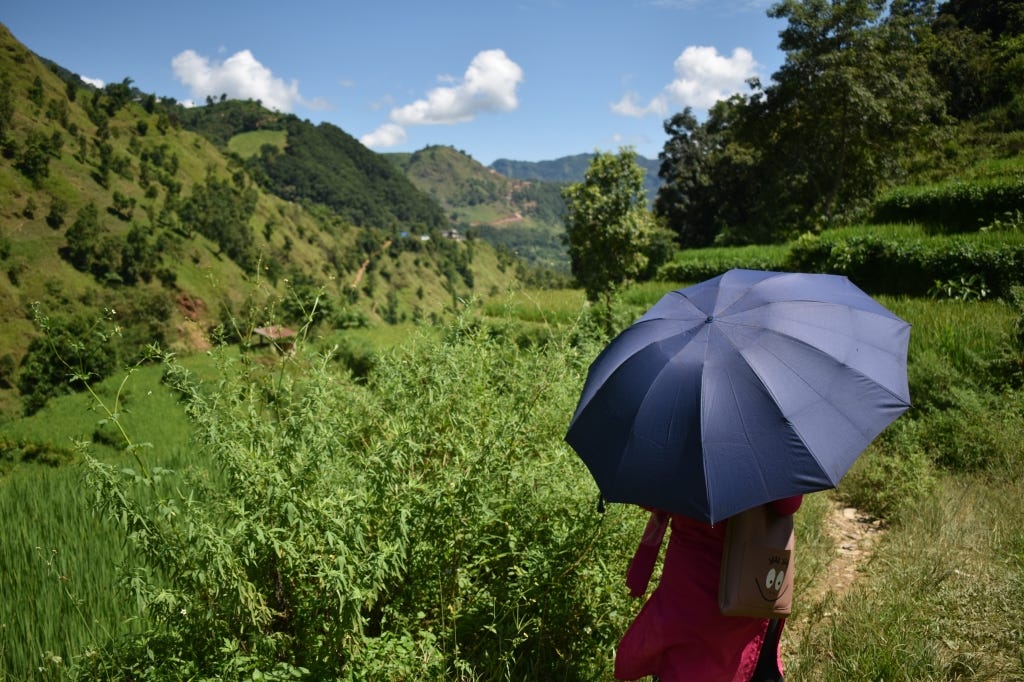
The municipality chose its own name, though there is some uncertainty about its true spelling. There does not appear to be a uniform phonetic translation of the name from Nepali to English, or if there is, it is not used in practice. The correct translation, judging from the International Phonetic Alphabet, and the one used by the national government is Bhirkot, but I have seen Vhirkot, Veerkot, and Virkot scrawled across different signs and maps. Our primary Nepali contact in the country seems to spell the municipality at whim in emails and texts, sometimes with a b and sometimes with a v. You see, the Nepali word भिरकोट is difficult to translate into English because the first sound, भ (bʰa), is somewhere between the English B (b) and V (v) sounds. It is also aspirated, hence the added h in Bhirkot[2], making English translations further inaccurate. The confusion over the name speaks volumes of the ambiguity of the region. While Virkot or Bhirkot might now be somewhere on a map, no one is really sure where it is or what it is called.
From now on, though, I will continue to use the name Virkot for two specific reasons. First, the correct spelling of English phonetic translations does not matter in the slightest in Virkot, Nepal. Spellings and pronunciation follow no pattern and vary based on who you ask. Words and rain have much in common in Nepal: complete unpredictability. Second and more importantly, Virkot is the moniker chosen by the institution at which we lived during our time in the municipality. That is, the illustrious Virkot Villa.
The hotel stands four stories tall, the bottom three devoted to rooms and the top a roof-deck with the bar and kitchen. The building is at the top of a hill after a steep, rocky road, and across a bridge over the Aadhi Khola river. Banana palms surround the hotel from the bottom like a green cloud and insects of the variety I have never heard make sounds as loud as sirens. Critters of all shapes and sizes are common in the Villa too. I would recount my day-long battle with a spider the size of my hand but am afraid the retelling would haunt my dreams...
The Virkot Villa is not luxurious, but the beds are clean (mostly), the electricity works (most of the time), and food and drink are available at decent prices. The roof deck bar provides panoramic views of both the river valley to the east and the mountains to the west. Though I call them mountains, the Nepalis, understandably, describe the upwards of 2000-meter mounds of earth as “hills” in comparison to the Himalaya. Everywhere you look in Virkot, breathtaking rice-patties roll over hills. Mist often shrouds the valley in the mornings after an evening of rain. On a clear day, you can see the Annapurna range of the Himalaya poking its heads out above the hills, the scale of the mountains too large to describe in words, even from such a distance.
Like most hotels, Virkot Villa is defined by its physical location and the people who inhabit it, clientele and staff included. At the villa, all of these are curiosities. My good friend and research partner, Mette, and I stayed at the Virkot Villa for the better part of two weeks, and I still find myself asking, who is this for? It sits off the beaten path of the highway, only heading toward rural mountain village communities. There is a paragliding station on top of one of the mountain peaks, but that station has its own lodging so tourists can avoid navigating up the long, treacherous roads too often. It’s also not for passerby Nepalis looking for a room; it’s too inconvenient and rooms run a bit more expensive than the average Nepali trader en route to India would want to pay.
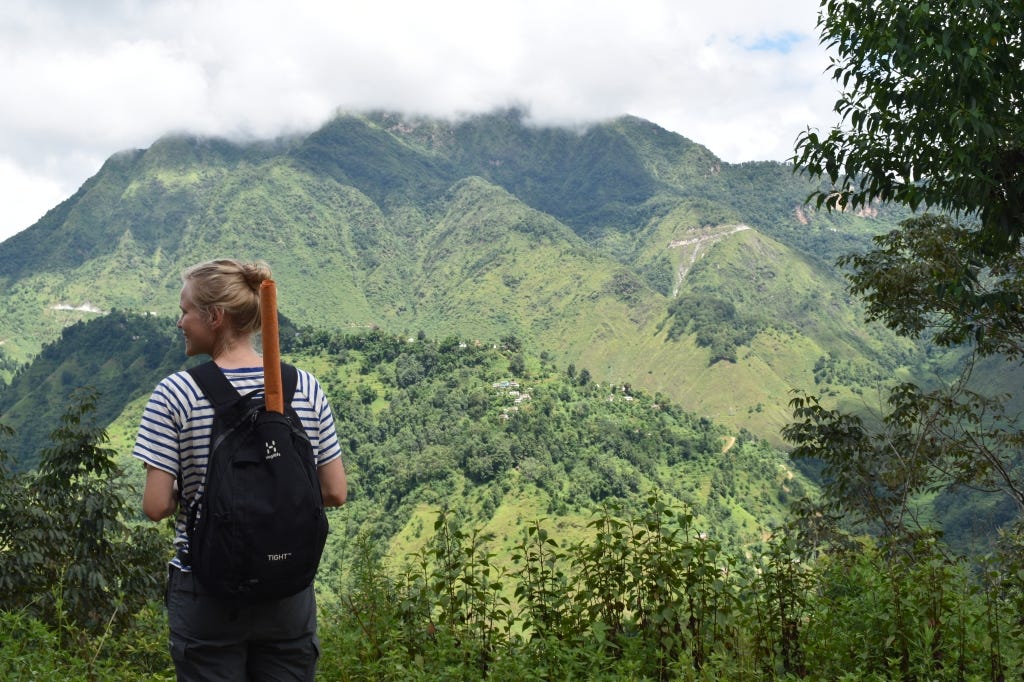
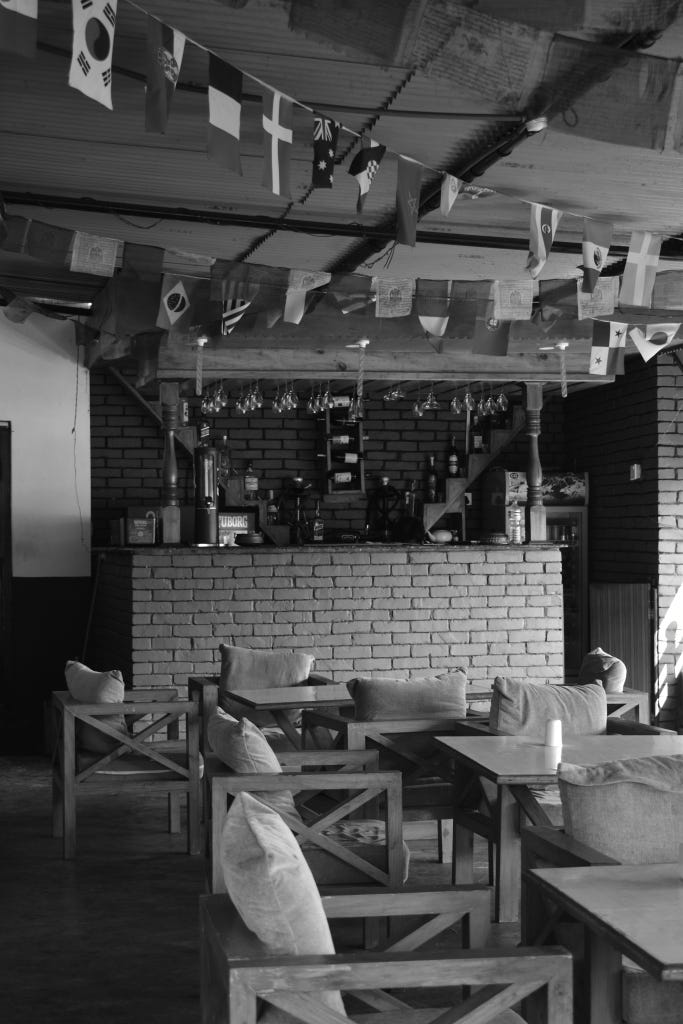
It was quiet most nights at the Villa. We would waste away the evenings playing cards and preparing for our work the next day with usually little distraction. Few others frequented the hotel. The intended demographics of the Virkot Villa are seemingly limited to two types of people: Young, relatively wealthy local Nepalis looking for a decent place to have a drink, and the occasional Western researchers using the locale as a base-camp to access the village communities above in the hills. We, being the only regular guests in the hotel, got to know the proprietors in a way you meet people only when toiling away shared hours. They did not have much to do, the staff of Virkot Villa, other than chat with us about the weather and occasionally bring a cup of tea or two.
The team was made up of a younger boy, a rotation of slightly older guys, the manager, and the owner. The kid, no more than 16, was bored 24-hours a day. When not helping prepare breakfast or cleaning tables, he sat religiously in one of the beige-cushioned chairs, staring into his landscape-oriented phone. I don’t think I heard him say a single word in my weeks at the Villa, and he would occasionally ignore us if we tried to ask him a question. I quite liked him.
The assortment of other dudes – and it would be difficult to describe them as anything other then dudes – cooked and serviced the food between their times reigning dominion over the pool table and chatting in the kitchen. Depending on which dude happened to be in the kitchen any given day, identical orders could turn out dramatically different. Our go-to breakfast of potato paratha (a kind of pan-fried dough similar to chapati) would resemble a thin, deep-fried donut one day and a thick potato quesadilla the next. We never really knew what we were going to get, but generally, the dudes could cook. They also had a strange formality in the way they addressed and served us. Though the normal barrier between customer and server dissolved as we sat and watched Indian television together, whenever it came time for dinner, they would laden us with over formal excuse me’s and you’re welcome’s worthy of a Michelin starred restaurant. Their eccentricity could probably be attributed to the cultural and linguistic gap between us, but that couldn’t keep me from wanting to tell them to loosen up.
The proprietor of the establishment was a squat, middle-aged man who had rented operation of the hotel from the headmistress of the nearby school. He kept a pig farm as a side business while his wife worked as the toll-taker on the only bridge that connects the Villa (and the nearby villages) to the main road. The food he prepared was always be delicious and, surprisingly, presented with subtle flair. A biriyani dish of his creation might be topped with a sliced arrangement of peppers or hardboiled egg. When out of the kitchen, he spent the evenings catering to the men who frequented the hotel as a watering hole. The locals would stagger in throughout an evening, drink the distilled and diluted whiskey hanging behind the bar, and then leave before the evening became too late, apparently driving themselves by motorcycle down the rough roads back to the market town below. Given the lack of other guests in the hotel, it could be assumed most of the business of Virkot Villa came from these men and their drinking habits.
The last man who helped operate the hotel – and if it seems like there are too many characters for a largely empty hotel in the middle of rural Nepal, you might be onto something – was our favorite companion-in-tedium. Surya is a mid-thirties orange farmer with great English skills and the demeanor of a maître-d’hôtel for a hotel far less obscure than Virkot Villa. He was kind, respectful, knowledgeable, and eager to help. When I caught a cold, he asked the dudes to prepare me the Nepali version of hot ginger water (i.e. with sugar in spades). As we watched the Indian sport of kabaddi on television together, he explained the rules and importance of the sport, both in India and Nepal.
He had left, like many of the young men in Nepal, to work in the Gulf states. His job had been as a gas-station attendant at a filling station in Saudi Arabia. He remembered the heat most, which sometimes reached temperatures upwards of 50°C (122°F). “Yeah really, 50,” he said to us in our disbelief. I had to go back and check whether that was true, and sure enough, the highest temperature ever recorded in Riyadh was 53° in 2017[3]. The highest ever recorded on earth: 54°. The man had worked, outside, in one of the hottest places on earth, and he sat recounting the memory to me like it was any old job. Surya left Saudi and returned to Nepal. Not too long after, he tried to go to the U.S. with the help of his Uncle who is currently living there. Twice, he applied for a visa and was rejected. After that, Surya decided it was not worth all the paperwork and effort to apply again. Surya now works on his father’s orange orchard a few kilometers from the hotel. He showed us pictures of their commercial agroforestry, his big smile on full display. The business had been successful; spliced variants had given them better results and they had plans to diversify in the future. He invited us to visit the farm when we had some free time and the weather improved, obviously proud of his home and work.
Surya often talked about the staleness he saw in Nepal, how all things are slow to improve. Behind that pessimism, though, Surya exhibited a sincere hope for the future. “But this is changing,” was his favorite line to append to the end of conversation. He would bring up how little education and opportunity the people of his area have available to them. But this is changing as a new wave of better educated teachers begin their careers and roads are granting greater connection to the disparate communities. He lamented the sluggishness with which the Nepalis moved away from the subsistence lifestyle they had been living more centuries, some uneager to take paid jobs because they are able to get by without. But this is changing as novel income sources create new surpluses and diversity. He complained about governance issues that left the operation of the country unviable. But this is changing as the most-recent constellation of the government has started to better support the rural communities in the area. To him, Nepal is still behind the curve. Yet, there are reasons to believe the tide is shifting.
As with everything else in the Virkot Villa, Surya is an oddity. His contemplative, questioning nature simply did not belong as the manager of what amounts to a roadside stop along a road no one goes down in the middle of rural Nepal. In that great big building, with its many insects and bottles of liquor and incongruity of place, Surya stood out as inapposite. He didn’t belong there any more than we did. It was him that convinced me of the strangeness of it all. There, in a hotel halfway to nowhere surrounded on all sides by sublime beauty, the three of us could sit over a cup of tea and chat about wistful dreams of the future. Nothing about the situation - the staff, the location, the grand humor of us being there in the first place - really made sense when I think about it, but maybe that’s why I shouldn’t. In a country where everything is changing and so much is staying the same, it can be impossible make heads or tails of what you see, and the Virkot Villa perfectly encapsulates that feeling. Like Nepal, it exists as a place between other places, standing as an obscurity. Why it exists, I do not know, but I am glad it does.
[1] https://kathmandupost.com/miscellaneous/2017/03/15/744-new-local-units-come-into-effect
[2] Matthews, D., 1993. A Course in Nepali, New Delhi: Heritage Publishers.